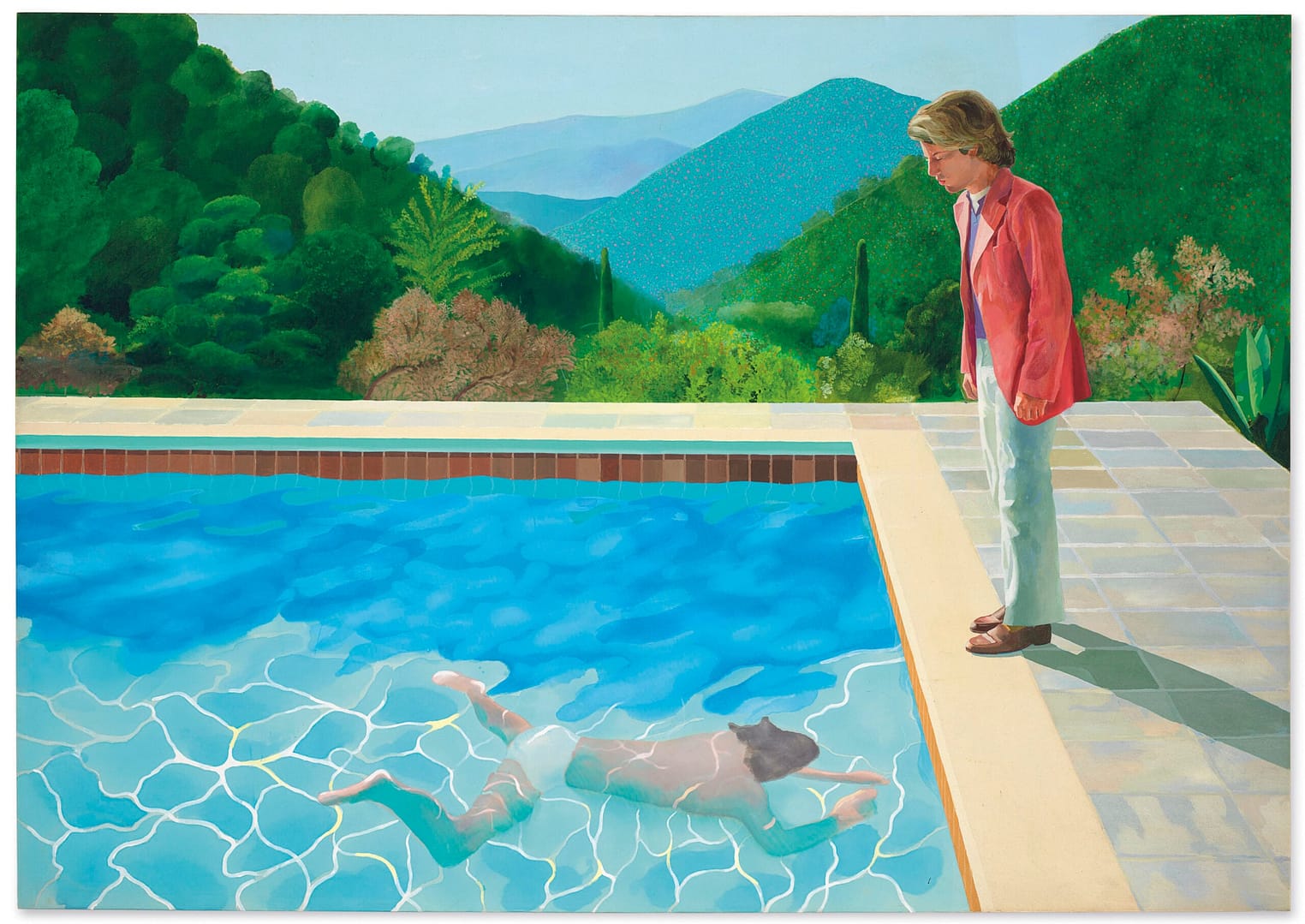
Portrait of an Artist (Pool with Two Figures) by David Hockney. His acrylic-on-canvas painting is sometimes classified as pop art, though Hockney held that none of his work fit into a category.
Art of the Pool and Pool as Art
How swimming pools elevate designs for outdoor living and inspired works by three modern artists
We often write about the art of the pool. Usually it’s a story of how a pool design elevates the art of an outdoor living project. But works by these three artists demonstrate how pools and swimmers can elevate art.
David Hockney, a West Yorkshire Englishman, arrived in Los Angeles in 1964 and fell in love with Southern California’s outdoor lifestyle. His bright acrylic paintings of swimming pools captured a sunny vibe that would spread across America.
His poolscapes were among his most widely acclaimed paintings. In 2018, the painting, pictured above, “Portrait of an Artist, (Pool with Two Figures)” sold at Christie’s for $90.3 million, which set a record price.
“The world is very, very beautiful, if you look at it,” Hockney said in an interview published by the Louisiana Museum of Modern Art in Humlebæk, Denmark in 2019. Though he returned to Europe later in life, he spent much of his time in LA for some 50 years. Hockney died at 88 in June 2026.
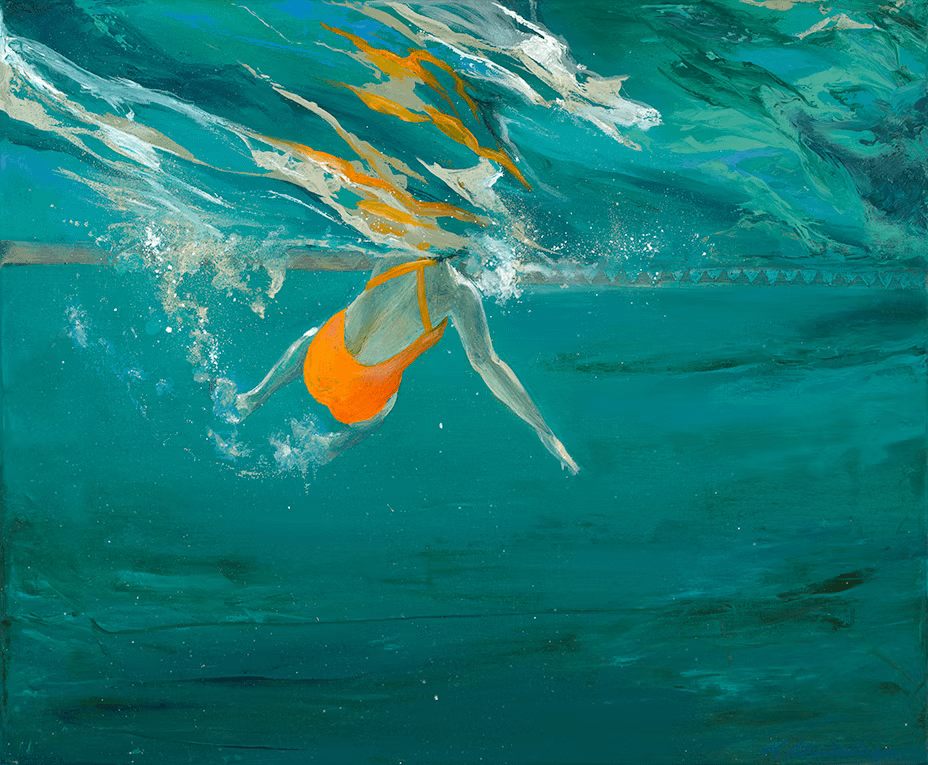
Garibaldi by Kathleen Streitenberger. She lays oil paint on canvas, using a palette knife to capture the water’s reflections and a swimmer’s movement through the water.
When Pool Love Turns into a Career of Swimming Pool Paintings
Next we go from L.A. to Ohio, where Kathleen Streitenberger has dedicated much of her art career to her love for swimming pools. Born in Cincinnati, she graduated from Columbus College of Art & Design. You can find samples of her work on her website, where she describes her “joyful life of color and art,” and her love of “the simple beauty of swimming pools.”
In “For the Love of Art and Swimming Pools” (Aqua Magazine, November 2024), Laura Carew tells how Streitenberger fell in love with swimming pools thanks to a classic public pool in Cincinnati. “I spent my whole childhood there,” Streitenberger said. She called it “my happy place.” She added, “All of my paintings are blue and underwater. It has to be blue, and it has to be a pool.”
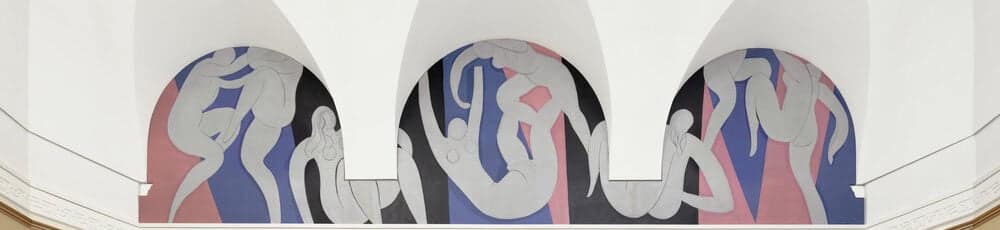
Henri Matisse. The Dance, Summer 1932 – April 1933, Oil on canvas; three panels. The Barnes Foundation.
The Barnes and Matisse: The Dance and the Swimming Pool
From Ohio, we travel on to Philadelphia and back to 1930, where a commission from Alfred Barnes revived the art career of Henri Matisse. He then produced a mural for the Barnes Foundation unlike anything anyone had done before.
Matisse would name his work “The Dance,” a composition of eight figures floating across three arches spanning 45 feet. To meet the tight construction deadline, he created pre-colored, full size cut paper images that he could position and move around a full-sized mockup. The mural was completed in 1932 and was later moved to the main gallery of the new Barnes Foundation on Benjamin Franklin Parkway in Philadelphia. From here, we travel forward in time to the last Mural Matisse created and then make a short trip to New York.
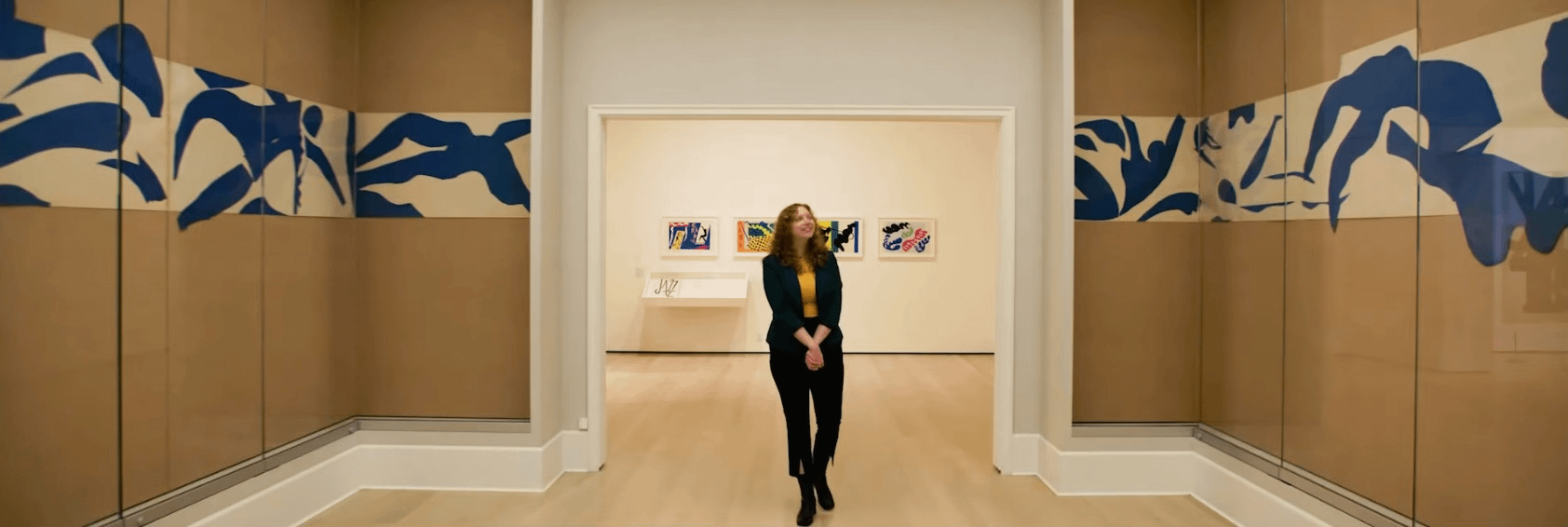
Josephine McReynolds reflects on Henri Matisse’s “Swimming Pool” and how the work evokes memories of her own childhood days in a swimming pool.
Dancers, Swimmers, and Movement
To capture the dancers’ movement in “The Dance,” Matisse transformed bodies into flat shapes that dance across the walls. This “mural in motion” would continue to capture Matisse’s imagination from the dance, to the sea, and the swimming pool.
Matisse frequently visited a swimming pool in Cannes, where he drew inspiration for his art. In the summer of 1952, however, he found he could no longer tolerate the heat. He returned home to Nice and announced he would “make myself my own pool,” which would adorn his dining room walls.
Our story ends in New York City. After Matisse’s death, the Swimmers mural was moved to the Museum of Modern Art in New York, where it was carefully restored and installed in its own dedicated room. Josephine McReynolds takes you on a tour in this YouTube video where she connects the Matisse swimmers to her own fond memories of summer days in a swimming pool.
The Emotional Pull of the Pool
The poolscapes of these three artists carry a classic modern style from the twentieth century into the twenty-first century. Their art reflects a special sort of modern abstraction that captures the emotional pull of movement. Its pull is especially strong when viewing bodies of water and bodies moving through water. It’s the same pull you can feel today when you step into a well-built outdoor living space and its classic midcentury swimming pool.