How to Realize Your Vision for Outdoor Living at Home
A Step-by-Step Introduction to the Budd Quality by Design Process
Budgets, master plans, and designs
“Design is a time-consuming process,” Chris Volk says, “but it makes everything easier in the long run.” Whether the project is modest or extravagant, Chris follows the same design principles: understanding the site conditions first, working toward a budget and master plan, and developing a thoughtful, beautiful design.
As we will emphasize throughout this design series, our Quality by Design process extends to every phase of a well-lived outdoor living project, from Design, to Build, to Maintain, and Renovate. Designing to ensure a smooth transition to each phase is the essential first step in the Quality by Design process. A manufacturing process by the same name (abbreviated QbD)1 has proved its value in the world’s most complex and challenging industries.
Budgeting by design
The Budd outdoor living process starts with an exploratory call. During the conversation, Chris asks clients to imagine their dream space without budget constraints. From there, they work toward a target budget that aligns their vision with their financial expectations.
“My job is to educate you,” he says. As homeowners, you drive the financial decisions while Chris guides you through your options. “You’re the driver, I’m just the person who’s guiding the process.”
“It doesn’t matter the size of the project,” he says. “I don’t care if it’s a $50,000 project or a $2 million project.” Whatever the size or scope, the process starts with an accurate site assessment. Chris says the design must conform to what is physically possible on the property: “How can you design something without knowing existing conditions?”
The home visit and site walk through
For the next step, Chris schedules an on-site “walk and talk,” where he investigates the property’s physical characteristics and learns more about the client’s vision for the outdoor space. They then sit down for a deeper discussion. Chris covers a wide-ranging set of questions that help establish the full scope of their new project. Sometimes the conversation leads Chris to draw some quick sketches to illustrate what he’s describing.
After the meeting, Chris follows up with an email recap to confirm details before proceeding to develop a design proposal and contract. The proposal provides a detailed accounting of the design fee and site survey. The site survey provides essential details such as utilities, downspouts, and trees that aren’t included in the typical home survey produced when buying a home. An engineering survey and report may be added if required to address underlying topographical issues.
Creating a master plan
Designing begins with hand sketches that evolve into CAD drawings and 3D renderings. The process ultimately leads to a thoughtful master plan that aligns with the property’s physical features, the homeowner’s lifestyle, and how family members expect to use the space.
The first design presentation is conceptual, inviting client feedback before progressing to further design refinement, followed by detailed construction plans. It’s an iterative process. Throughout design development, Chris says he seeks continual client feedback.
He credits his wife for helping him learn to listen carefully and check back frequently. During the early discovery phase, he often sketches initial ideas in their meetings, keeping the designs fluid as the homeowners’ wishes and goals evolve.
It takes time and patience on the part of the designer and clients. “Sometimes that involves jumping around a little bit,” until he finally uncovers his clients’ deeper visions.
Understanding the principles and elements of good design
Homeowners often struggle to express what they want in their outdoor space. “They might say, ‘I’m just not in love with an initial design,'” he says, “but when you ask, ‘what is it?’ they don’t know.” He sometimes finds himself explaining the principles and elements of design. “I don’t go into all the technical details, just touch on relevant concepts that help move the conversation forward.”
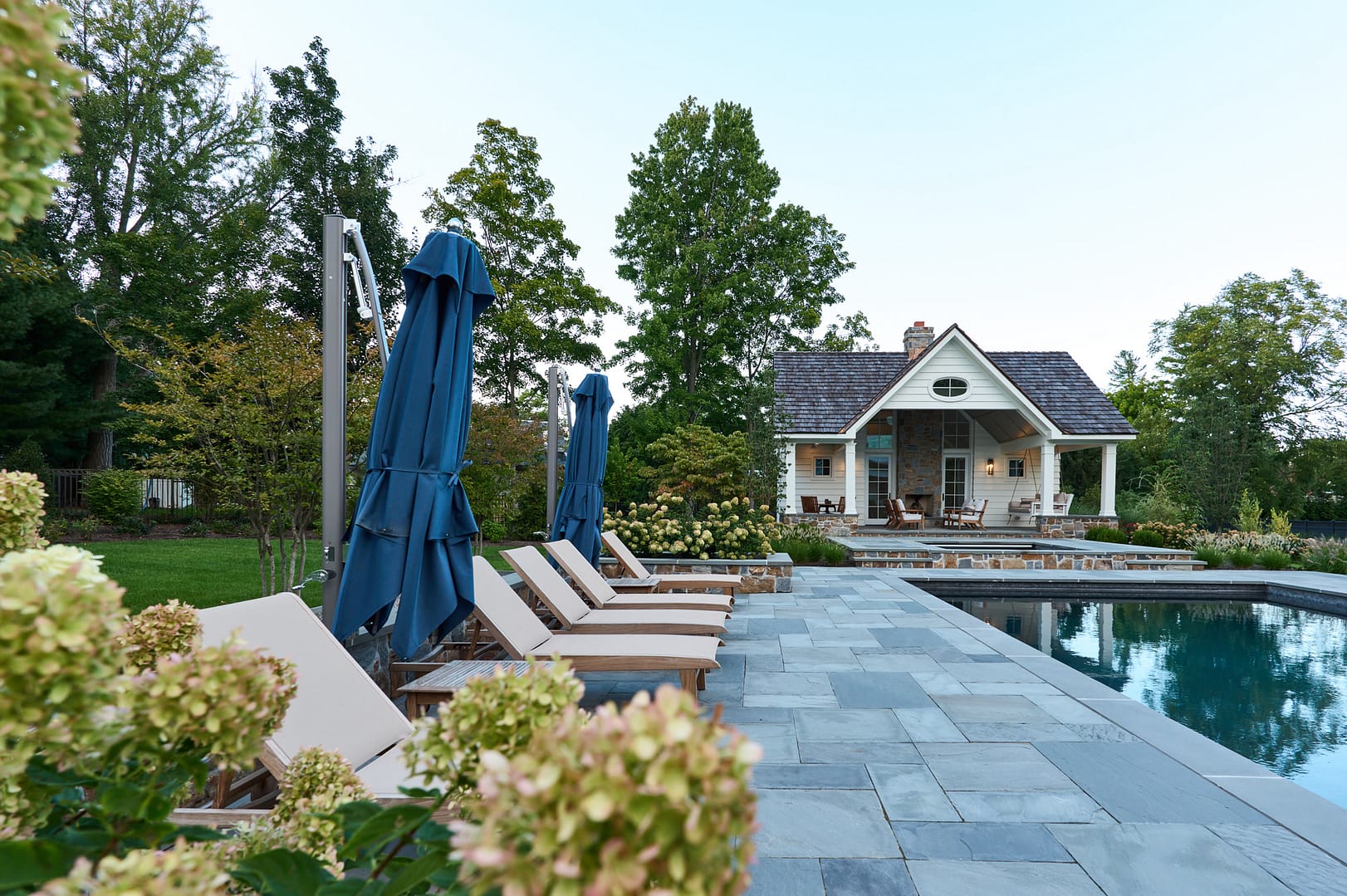
He says it’s often a question of function, balance, or contrast. Patio design is a good example: Some builders default to a single large, monotonous patio with no visual interest. “It looks like a helicopter pad,” he says.
This is where the power of subtle design decisions makes all the difference. Touches like contrasting colors, varied materials, elevation changes, and carefully placed inlays create clearly delineated areas within the space. “You can have so much more visual impact and make it have meaning,” he says. The secret is to break the space into distinct zones with different functions and visual cues.
Rhythm, harmony, and contrasting spaces in outdoor design
Creating distinct and harmonious areas within a yard isn’t just a design principle—it’s a human need. By incorporating contrasting materials, elevations, or unique features, outdoor spaces become more inviting and functional. “It’s the way good architects and landscape architects understand design,” he says. Even simple adjustments can turn a bland outdoor area into a series of compelling destinations.
One of the super secrets of any art is the practitioner’s ability to make elements such as rhythm, harmony, and contrast work for you. Designers learn to recognize balance, emphasis, and proportion instinctively. “You know, when you go into any space, you’re like, ‘yep, that’s emphasis’ or ‘that’s balance,'” he says.
Developing that awareness elevates both the design process and the final result. It’s what a musician does when making music or what an artist brings to a painting. Those who continually practice their art, who obsess over quality and continuous improvement, develop a deep, intuitive understanding of what brings joy to others.
In harmony with house and landscape
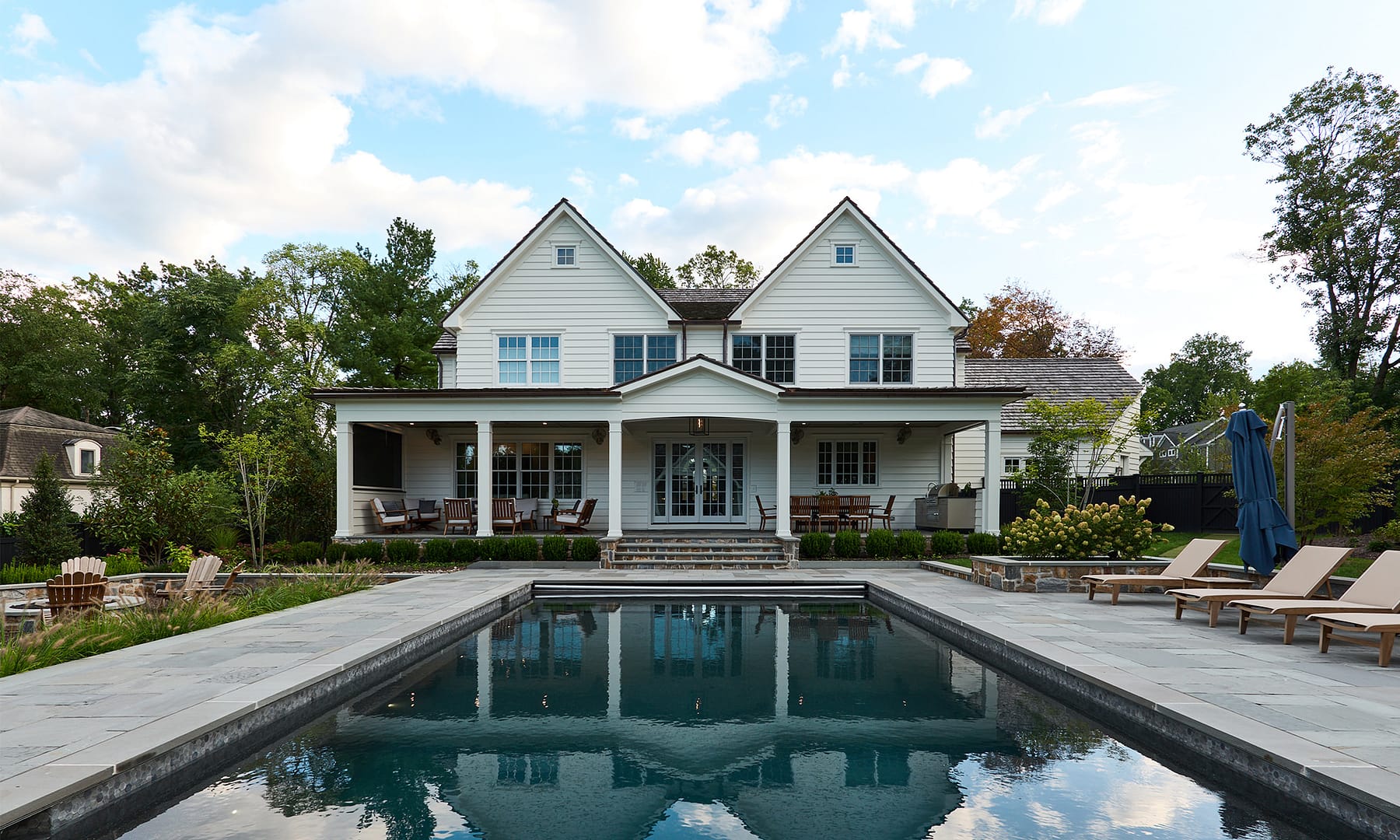
Another principle Chris follows is harmony. “You have to design outdoor spaces that complement a home’s architecture,” he says. When a house is already built, “You’re not going to tell a client, ‘Let’s change your roof peak’ or ‘Let’s change the material in your house.'” The challenge is to blend the outdoor space seamlessly with the home’s style, to create a sense of harmony throughout the property.
Designing for sustainability, maintenance, and longevity
Good design goes beyond aesthetics and accounts for long-term maintenance and functionality. “You know, code is the bare minimum,” Chris says. “Code doesn’t dictate sustainability.”
Neither does code mandate practical, serviceable designs. For example, when placing pool equipment, Chris consults with his service team to ensure they have adequate access to heaters, pumps, or filters. “If I’m going to have a technician go out and work on a heater, for example, and they have to crawl in a space that’s six inches by eight inches, how good of a job do you think they’re going to do?”
Get experts involved before you build
The same principle applies to decks, patios, and landscaping. By involving knowledgeable specialists early in the design process, Chris ensures his designs are practical and maintainable. “Paper is cheap,” he says, and that’s where you want to make the changes. You want to discover and resolve potential issues during planning, not after construction.
No one is an expert on every detail of a complex project. Chris says you may need to look beyond yourself and those in your company. You may need to consult hydraulic engineers, structural engineers, or architects. By assembling the right team during planning, your project runs more efficiently and smoothly, with fewer errors and less stress for builders and homeowners. Good plans lead to greater efficiency, and efficiency “creates a better experience,” he says.